

Article Highlights
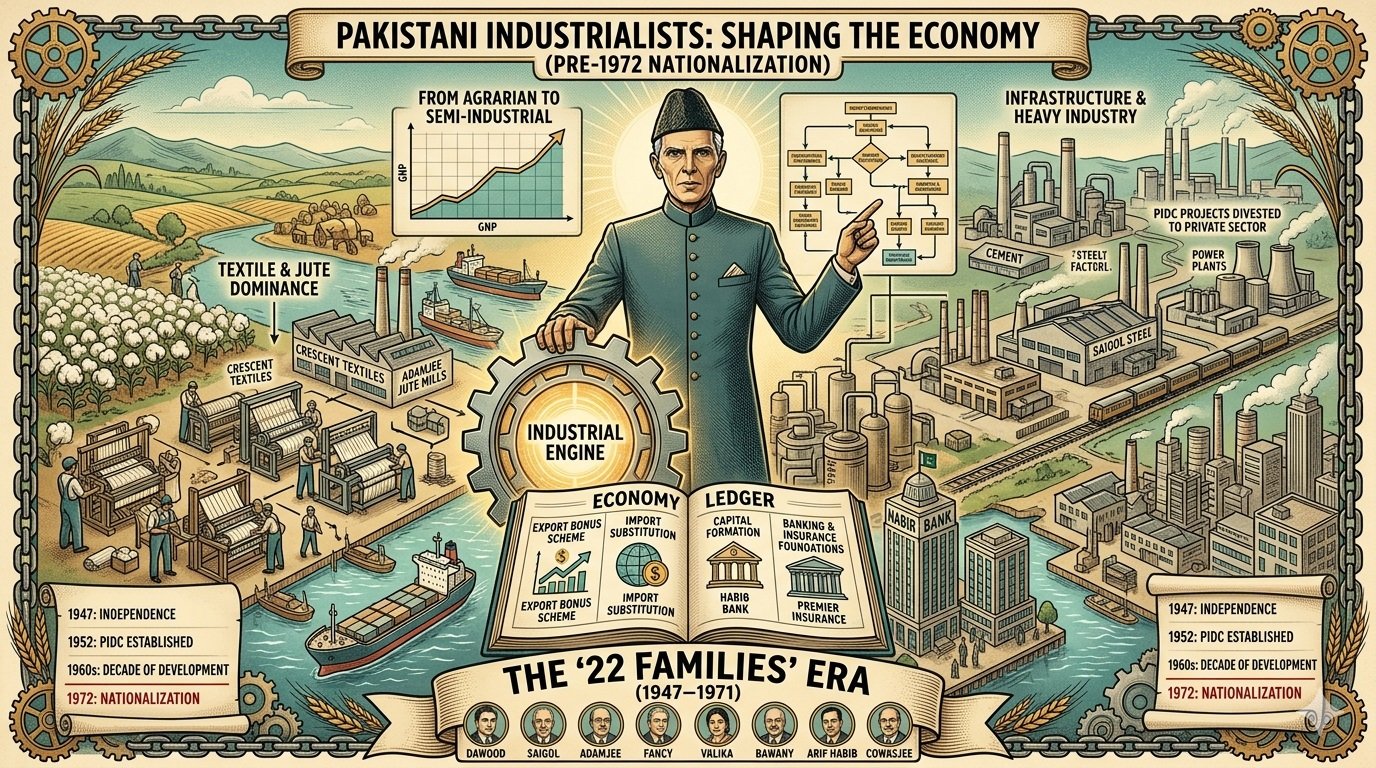
- Several world-class Pakistani industrialists and business families before the 1970s.
- Major industries included textiles, banking, engineering, agriculture, and aviation.
- Nationalization dramatically changed Pakistan’s industrial landscape.
- Many leading business families lost their industries and investments.
- The debate over nationalization’s long-term impact continues today.
Introduction
Whenever people compare Pakistan’s economy with neighboring countries, one question often comes up: Why does Pakistan not have business families like Ambani, Tata, or Birla today?
From my observation, this question cannot be answered without looking at Pakistan’s own history. Many young people are unaware that Pakistan once had its own powerful industrialists, bankers, entrepreneurs, and manufacturers. In fact, several Pakistani industrialists played a major role in building industries, creating jobs, and contributing to economic growth during the first decades after independence.
Understanding their story provides important insights into the country’s economic journey.
The Golden Era of Pakistani Industrialists
During the 1950s and 1960s, Pakistan experienced significant industrial growth. Many Pakistani industrialists invested heavily in manufacturing, textiles, banking, engineering, transportation, and agriculture.
The country was often viewed as a developing economy with strong industrial potential. Large business groups established factories, introduced modern technology, and created thousands of employment opportunities.
During this period, Pakistani industrialists were widely recognized for their entrepreneurial vision and willingness to invest in long-term industrial development.
Business Families That Helped Build Industries
Several well-known business families contributed to Pakistan’s economic development.
The Dawood Group
The Dawood Group became one of the country’s most influential industrial groups. It played a major role in heavy industry, agricultural machinery, fertilizers, and manufacturing. The group helped expand Pakistan’s industrial base at a time when local production was still developing.
The Habib Family
The Habib family made major contributions to Pakistan’s banking sector. Their financial institutions supported businesses and industrial expansion throughout the country.
One of the most notable symbols of their success was Habib Plaza in Karachi, which was regarded as one of the most modern commercial buildings of its time.
The Sehgal Group
The Sehgal Group contributed significantly to Pakistan’s textile industry. Textiles became one of Pakistan’s strongest export sectors, providing foreign exchange and employment opportunities.
The Isfahani Family
The Isfahani family was involved in tea, trade, shipping, and other commercial ventures. Their business activities connected Pakistan with international markets and helped strengthen trade relations.
The Sharif Family and Ittefaq Group
The Ittefaq Group became known for engineering and manufacturing. The group contributed to agricultural equipment production and industrial development.
Many industrial projects associated with engineering and manufacturing expanded during this period, helping modernize various sectors of the economy.
Growth of Manufacturing and Engineering
Pakistan’s manufacturing sector witnessed remarkable progress during the 1960s. Companies assembled vehicles, motorcycles, bicycles, machinery, and industrial equipment.
Factories in Karachi, Lahore, and other industrial centers produced goods that supported domestic demand and reduced dependence on imports.
Industrial estates became symbols of economic progress. Many Pakistani industrialists invested in technology and production facilities that were considered advanced for their time.
The Debate Around Wealth Concentration
As industrial growth continued, concerns emerged regarding wealth concentration among a relatively small number of business families.
Critics argued that economic power was becoming concentrated in a few hands. Supporters, however, believed that industrial investment was essential for economic development and job creation.
This debate eventually became a major political issue during the late 1960s and early 1970s.
Nationalization and Its Impact
The nationalization policies introduced during the 1970s fundamentally changed Pakistan’s economic structure.
Many industries, banks, educational institutions, and businesses were brought under state ownership. The objective was to reduce economic inequality and increase government control over key sectors.
However, opinions remain divided regarding the results.
Supporters argue that nationalization sought to address social and economic disparities. Critics believe it discouraged private investment and weakened entrepreneurial confidence.
Many Pakistani industrialists saw their businesses transferred to government control, leading some families to reduce investments or move business activities abroad.
Long-Term Effects on Industry
The impact of nationalization continues to be discussed by economists, historians, and business experts.
Some analysts believe that Pakistan lost valuable entrepreneurial talent during this period. Others argue that multiple factors, including political instability, governance challenges, and changing global economic conditions, also influenced industrial performance.
What is clear is that Pakistan’s industrial sector underwent a major transformation after nationalization.
The story of Pakistan Industrialists remains closely connected to these changes.
Lessons for Future Generations
One important lesson from history is that sustainable economic growth requires a balance between industrial development, fair competition, regulation, and investment confidence.
Successful economies often encourage entrepreneurship while maintaining policies that promote broader economic participation.
The experiences of Pakistani industrialists demonstrate how business leadership, innovation, and long-term investment can contribute to national development.
At the same time, they highlight the importance of economic policies that create stability and encourage future investment.
Conclusion
The history of Pakistan’s industrialists is an important chapter in the country’s economic development. Long before comparisons were made with foreign business dynasties, Pakistan had its own entrepreneurs, manufacturers, bankers, and industrial pioneers who helped build industries and create opportunities.
While opinions differ regarding the causes of industrial decline and the effects of nationalization, there is little doubt that these business leaders played a significant role in shaping Pakistan’s economy.
Understanding their contributions allows newer generations to gain a more balanced perspective on Pakistan’s economic history and the challenges that continue to influence the country’s industrial future.