

Article ighlights
- The Rivian R2 Performance achieves 105 MPGe combined and 32 kWh per 100 miles, matching the Tesla Model Y Performance exactly on both metrics.
- Despite being nearly 800 lbs heavier with a boxier, taller body, the Rivian R2 EPA efficiency holds its own against Tesla’s aerodynamically optimised crossover.
- The R2 Performance beats the Model Y on range, delivering 330 miles versus 306 miles, thanks to its slightly larger 86.8 kWh battery pack.
- Choosing the optional all-terrain tires drops the Rivian R2 EPA efficiency to 99 MPGe, showing just how much tire choice affects real-world energy use.
- With first deliveries starting June 9, 2026, and near-identical pricing, the R2 is now the most credible alternative to the Model Y on paper.
When the Numbers Surprised Everyone
I have been following electric vehicle efficiency data for a while now, and I will be honest: I did not expect this. When Rivian announced the R2, most of us assumed it would be a solid performer, but also assumed some efficiency penalty would come with the bigger, heavier frame. That is just physics, or so we thought. Then the EPA data landed on fueleconomy.gov, and those assumptions went out the window.
The official Rivian R2 EPA efficiency numbers for the Performance trim with 21-inch wheels and all-season tires are 105 MPGe combined, 114 MPGe city, and 96 MPGe highway. Energy consumption sits at 32 kWh per 100 miles, and total range is 330 miles. Those are not just good numbers. Those are Tesla-level numbers from a vehicle that looks like it belongs on a forest trail.
| Combined MPGe 105 Rivian R2 Performance | Range 330 mi vs 306 mi Model Y | Consumption 32 kWh per 100 miles | Battery Size 86.8 kWh vs 84 kWh Model Y |
Head to Head: R2 Performance vs Model Y Performance
Putting both vehicles side by side in the official data reveals something remarkable. The Rivian R2 EPA efficiency rating is not just close to the Tesla Model Y Performance. It is identical on the two metrics that matter most to most drivers: combined MPGe and energy consumption per 100 miles.
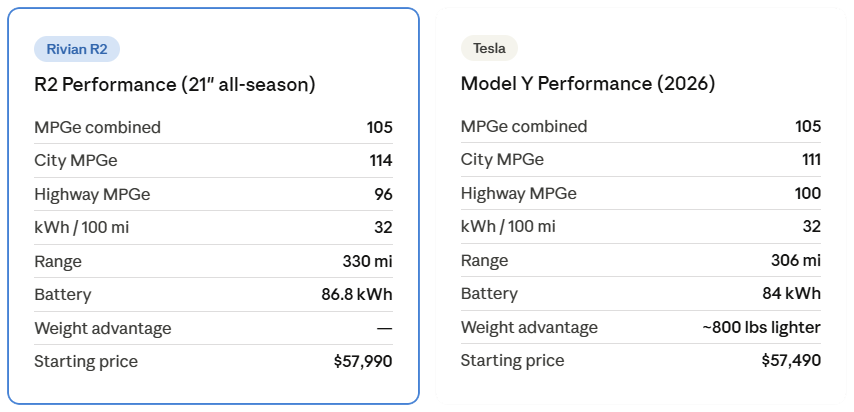
The Tesla Model Y Performance does edge the R2 on highway driving specifically, which makes sense. At higher speeds, aerodynamic drag becomes the dominant factor, and the Model Y’s sleeker roofline pays dividends there. But in city driving and combined use, the Rivian R2 EPA efficiency is equal or better. That is a genuinely impressive outcome.
Why Rivian R2 EPA Efficiency Is So Impressive Given the Form Factor
The R2 Performance weighs approximately 5,250 lbs. The Model Y Performance is nearly 800 lbs lighter. Add to that the fact that the Rivian has more ground clearance, a taller ride height, a more upright windshield, and a generally boxier profile, and you would expect a meaningful efficiency gap. Every one of those physical characteristics creates more aerodynamic drag. Every extra pound demands more energy to move. Yet the Rivian R2 EPA efficiency numbers say otherwise.
Part of the credit goes to Rivian’s new R2 platform. The R2 is roughly 1,300 lbs lighter than the R1S it sits below in the lineup, thanks to large-scale die casting, a redesigned drive unit, and a simplified suspension setup. Rivian clearly invested in weight-saving, not just in a lower price point but also in efficiency. The engineering work behind this result is significant.
Real-world efficiency can differ from EPA ratings. Independent testing will be the true measure of how both vehicles perform day-to-day, especially in mixed driving conditions across different climates.
The Tire Choice Makes a Real Difference
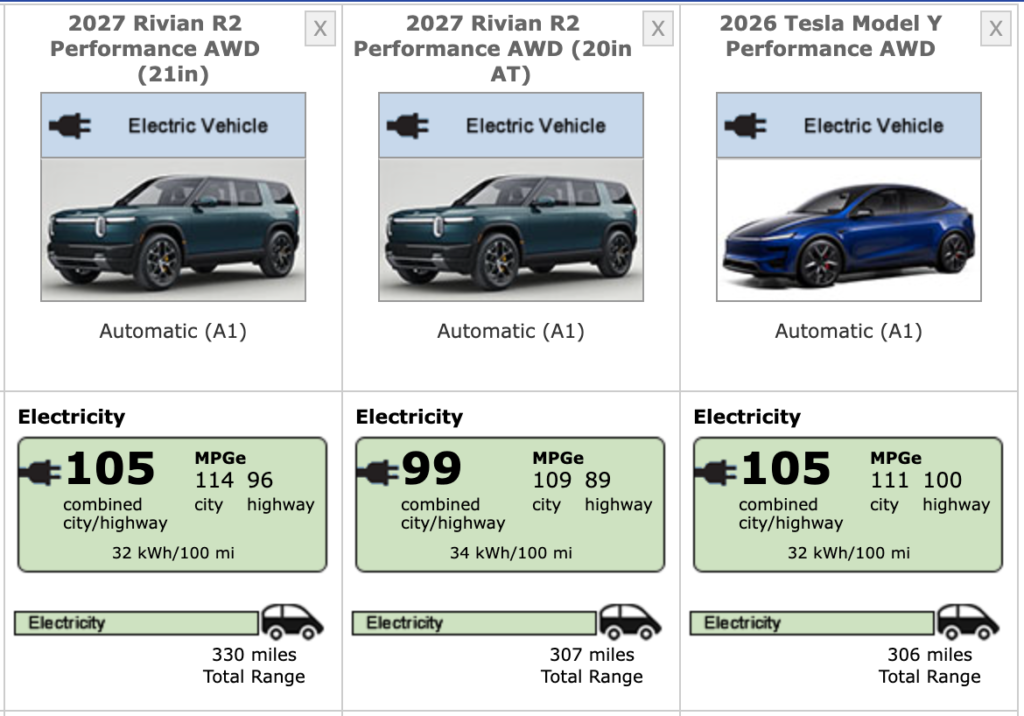
One detail worth paying close attention to in the Rivian R2 EPA efficiency data is what happens when you select the optional 20-inch all-terrain tires. The combined MPGe drops from 105 to 99, energy consumption rises from 32 to 34 kWh per 100 miles, and range falls from 330 to 307 miles. That is a significant penalty for a tire upgrade that many R2 buyers will naturally want given the vehicle’s adventure-oriented character.
This is a real and practical consideration for anyone shopping the R2. If you do most of your driving on pavement and care deeply about range and Rivian R2 EPA efficiency, the standard all-season setup is the clear choice. If you want all-terrain capability and occasional off-road use, you will pay for it in efficiency. The honest answer is that most owners will rarely need those tires on actual dirt, but the option is there for those who do.
Pricing Is Essentially a Wash
When Rivian R2 EPA efficiency matches the Model Y, and the price is within $500 of each other, the decision between these two vehicles becomes genuinely interesting. The R2 Performance starts at $57,990 with the Launch Package, which includes Autonomy+, the Tow Package, and a key fob. The Model Y Performance starts at $57,490. On price alone, there is nothing to separate them.
What you get for that money differs. The R2 offers more interior space, a more rugged and utilitarian design, and a battery that is slightly larger. The Model Y offers Tesla’s more established service network and the Supercharger advantage, though it is worth noting that Rivian owners can access the Supercharger network already. The cost advantage there has largely closed.
What This Means for the EV Market
Tesla has long set the standard for EV efficiency. It is one of the core reasons the company has been able to manufacture electric vehicles profitably at scale. Fewer battery cells needed per vehicle to deliver competitive range means lower costs per unit. When a competitor matches that efficiency benchmark while also offering a more spacious and rugged package, it changes the competitive landscape in a meaningful way.
The Rivian R2 EPA efficiency result is the kind of data point that will get serious attention from buyers who previously assumed Tesla had no real rivals on this metric. It is also a signal to the wider industry that efficient EV engineering is not Tesla’s exclusive domain anymore. With first deliveries arriving June 9, 2026, real-world data will start coming in quickly, and it will be fascinating to see how the numbers hold up outside the controlled conditions of EPA testing.
Automotive Analysts currently estimate around 22,000 to 23,000 R2 units in 2026, which is a fraction of Model Y production volume. But if Rivian can ramp supply to meet what will likely be strong demand, this vehicle has every ingredient to become a genuine bestseller. Rivian R2 EPA efficiency being on par with the Model Y was the last checkbox many buyers were waiting to see ticked.